
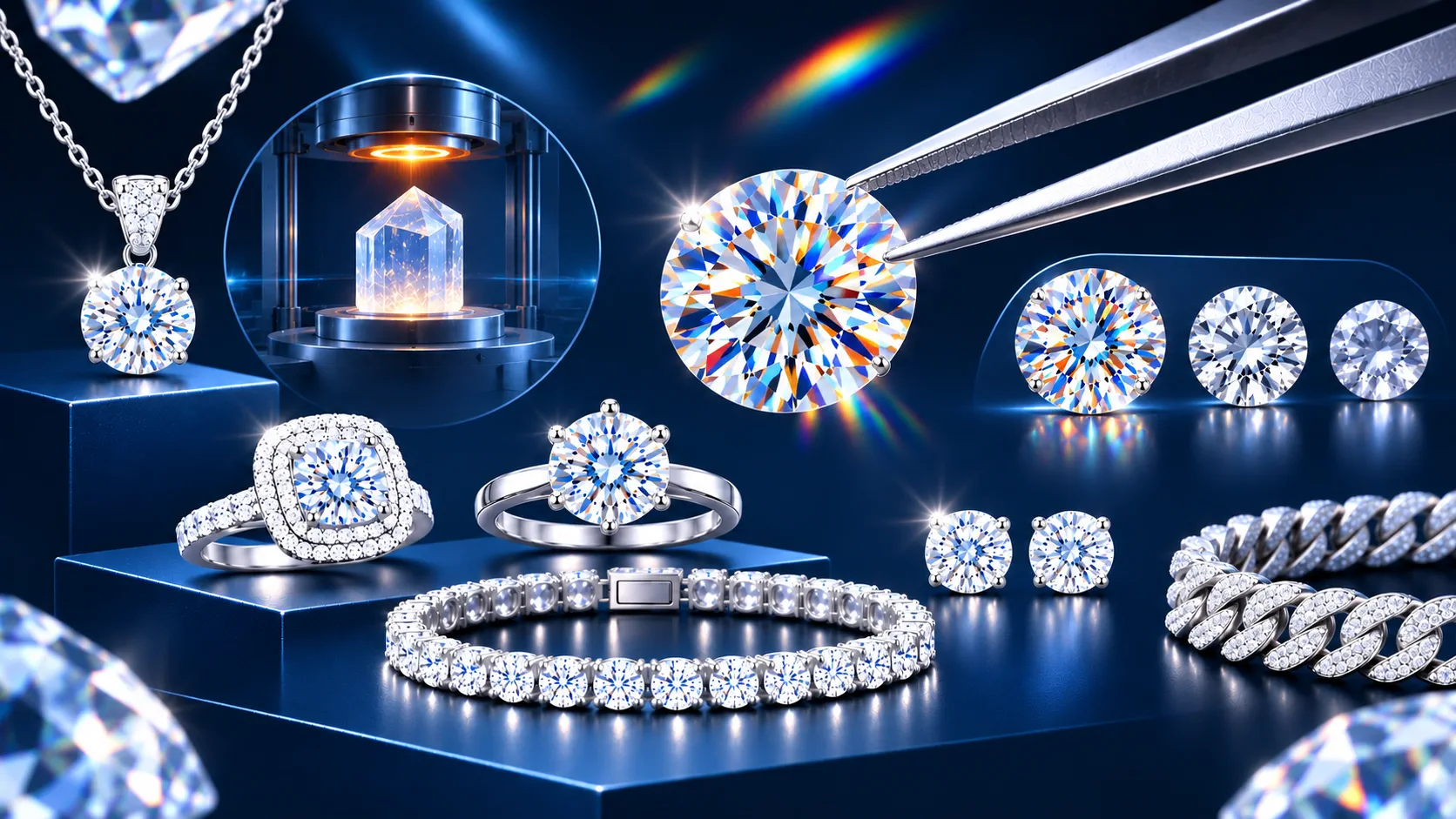
What Is Moissanite? A Complete Guide for Jewelry Buyers
Moissanite is a lab-grown gemstone made of silicon carbide (SiC). It looks very close to a diamond, but it is a different material: it has more rainbow “fire”, it is slightly less hard (9.25 vs 10 on the Mohs scale) and it costs a small fraction of the price. Almost all moissanite sold in jewelry today is created in a laboratory, because natural moissanite is far too rare and too small to cut into gems.
This guide explains what moissanite is, how it is made, how it compares with diamond and cubic zirconia, and what jewelry buyers and retailers should check before they buy. It is written by the team at JOVEGEM, a moissanite jewelry factory in Ningbo, China, so you will also find the practical details we deal with every day: grades, certificates, carat sizes and care.
Moissanite at a Glance
| Material | Silicon carbide (SiC) |
|---|---|
| Origin | Lab-grown (natural moissanite is extremely rare) |
| Hardness | 9.25 on the Mohs scale (diamond is 10) |
| Refractive index | About 2.65–2.69 (diamond about 2.42) |
| Dispersion (“fire”) | 0.104, more than twice diamond’s 0.044 |
| Typical jewelry grade | D–F color (colorless), VVS clarity |
| Common certificate | GRA certificate and card, with a laser-inscribed girdle |
Is Moissanite a Real Diamond?
No. Moissanite is a real gemstone, but it is not a diamond. A diamond is pure carbon; moissanite is silicon carbide. They have different hardness, different optical properties and different prices, and a trained jeweler or a moissanite tester can tell them apart.
It is also not a “lab-grown diamond”. Lab-grown diamonds are real diamonds (carbon) made in a lab. Moissanite is a separate gemstone that is also made in a lab. When customers ask “is moissanite fake?”, the honest answer is: it is not fake, it is simply a different stone that is sold as a diamond alternative, not as a diamond.
Where Does Moissanite Come From?
Moissanite was discovered in 1893 by the French chemist Henri Moissan, who found tiny crystals in fragments of the Canyon Diablo meteorite in Arizona. The mineral was later named after him. Natural moissanite has since been found in a few other places, but only as very small grains, never in sizes that could be cut into jewelry stones.
Gem-quality moissanite became possible only when scientists learned to grow large, clear silicon carbide crystals in the lab. It entered the jewelry market as a diamond alternative in 1998, and since then production has grown and prices have fallen, which is why moissanite is now common in engagement rings, tennis chains, earrings and hip hop jewelry.
How Is Moissanite Made?
Moissanite is grown as a crystal from silicon and carbon at very high temperatures in a controlled furnace. The rough crystal is then sliced, pre-formed and cut into facets by gem cutters, in the same way as other gemstones. After cutting, each stone is graded for color and clarity, and quality stones are sent for certification.
For buyers, the important point is that because the material is made under control, moissanite can be produced consistently: the same color, the same clarity and the same size, stone after stone. That consistency is a big advantage when you need hundreds of matching stones for a tennis chain or a collection of rings.
Moissanite vs Diamond vs Cubic Zirconia
| Moissanite | Diamond | Cubic zirconia | |
|---|---|---|---|
| Material | Silicon carbide | Carbon | Zirconium dioxide |
| Hardness (Mohs) | 9.25 | 10 | 8–8.5 |
| Refractive index | 2.65–2.69 | 2.42 | 2.15–2.18 |
| Fire (dispersion) | 0.104 (very high) | 0.044 | About 0.06 |
| Long-term look | Stays clear and bright | Stays clear and bright | Can scratch and turn cloudy over time |
| Price | A small fraction of diamond | Highest | Lowest |
| Passes a thermal diamond tester | Usually yes | Yes | No |
In short, moissanite sits between the two: it has the durability and brilliance to be worn every day for years, like a diamond, at a price much closer to fashion jewelry. Compared with cubic zirconia, it is harder, more brilliant and does not go cloudy, which is why many brands are moving their silver lines from CZ to moissanite.
What Does Moissanite Look Like?
A well-cut, colorless moissanite looks like a diamond to most people at normal viewing distance. The main visible difference is the fire: moissanite throws more colorful, rainbow flashes, especially in sunlight and in larger stones (around 2 carats and up). Some people love that extra sparkle; others prefer the whiter light of a diamond.
Moissanite also comes in colors. Besides colorless stones, our factory works with orange-red, green, blue, champagne and cherry blossom pink moissanite, which are popular for fashion rings and earrings.
Moissanite Grades: Color, Clarity and Carat
Moissanite is graded in a similar way to diamonds, so the terms will look familiar:
- Color: D, E and F are colorless. D color is the top grade and the standard for quality moissanite jewelry. Lower grades (G–H and below) can show a faint yellow or gray tint.
- Clarity: VVS1 and VVS2 mean the stone is “very, very slightly included”; inclusions are not visible to the eye. Most good moissanite jewelry uses VVS1 stones.
- Carat: moissanite is lighter than diamond (specific gravity about 3.22 vs 3.52). In the trade, a “1 carat” moissanite usually means a stone the same size as a 1 ct diamond, a 6.5 mm round, even though it weighs slightly less. This is often called diamond-equivalent weight (DEW). When you compare suppliers, always compare millimeter sizes, not only carats.
Quality moissanite is usually sold with a GRA certificate and card, and the stone’s girdle is laser-inscribed with a number that matches the certificate. You can read more about how we grade and check stones on our Quality & GRA page.
Is Moissanite Good for Everyday Jewelry?
Yes. With a hardness of 9.25, moissanite is harder than sapphire, ruby and every other common gemstone except diamond, so it resists scratches from daily wear. It also handles heat well, which is why jewelers can repair and resize moissanite pieces safely. A moissanite stone does not turn cloudy or change color with normal wear; if it looks dull, it simply needs cleaning.
In practice, the metal matters more than the stone. In 925 sterling silver jewelry, choose pieces with rhodium (white gold) or thick gold plating, and keep them away from chlorine and perfume to protect the plating. To clean moissanite, use warm water, a little mild soap and a soft brush, then dry with a soft cloth.
How to Tell Moissanite from a Diamond
- Diamond tester: most basic thermal testers show moissanite as “diamond”, because both conduct heat very well. A combined or electrical (moissanite) tester can separate them.
- Double refraction: under a loupe, looking through the side of the stone, moissanite can show doubled facet edges. Diamond does not.
- Rainbow fire: stronger colored flashes, especially in direct sunlight.
- Certificate and inscription: the easiest way. A GRA report and a matching laser inscription identify the stone as moissanite.
Why Jewelry Brands and Retailers Choose Moissanite
For jewelry businesses, moissanite solves a few problems at once. It gives customers the look of diamond jewelry at prices they can afford. It is durable, so returns for scratched or cloudy stones are rare. And because it is lab-grown and consistent, you can build large, matching collections: tennis chains, Cuban links, eternity bands and earrings, without the price swings and sourcing difficulty of natural diamonds.
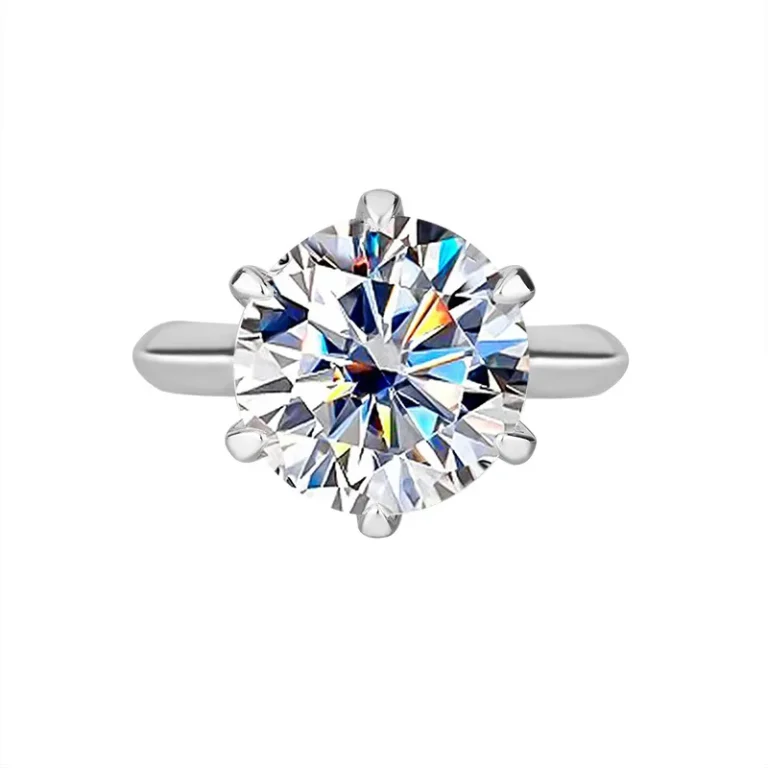
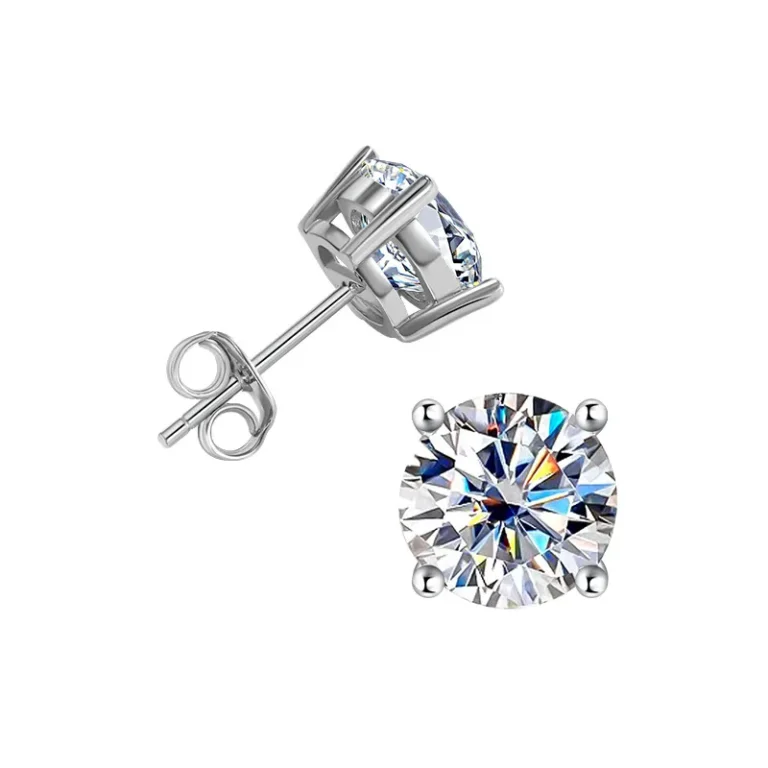
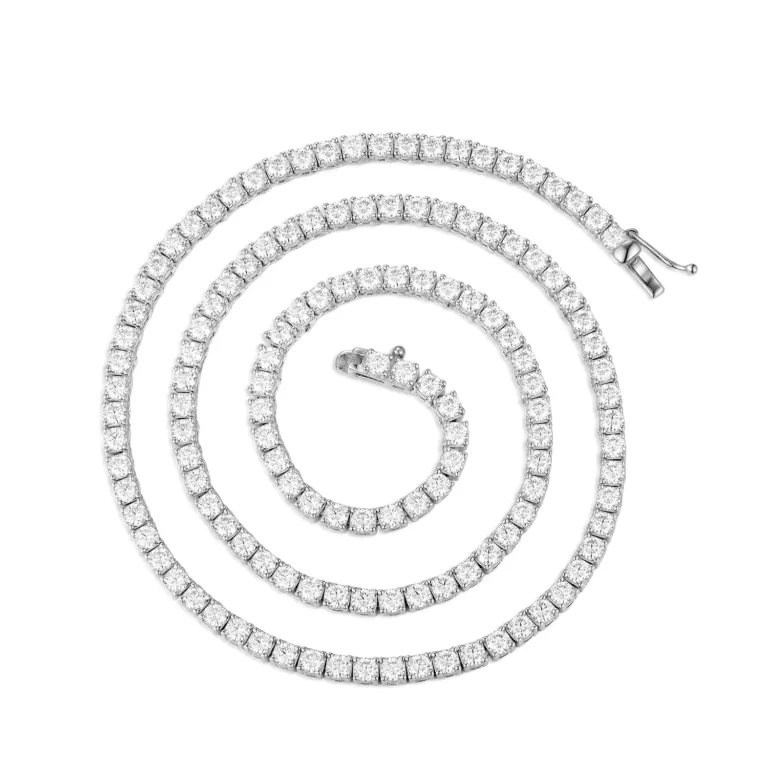
Moissanite also works well with 925 sterling silver. A D color VVS1 moissanite set in rhodium-plated silver gives a high-end look at a retail price point that suits online stores, boutiques and gift shops. Popular wholesale categories include moissanite tennis chains, moissanite engagement rings, Cuban link chains and hip hop jewelry, and stud and huggie earrings.
Moissanite Jewelry from Our Factory
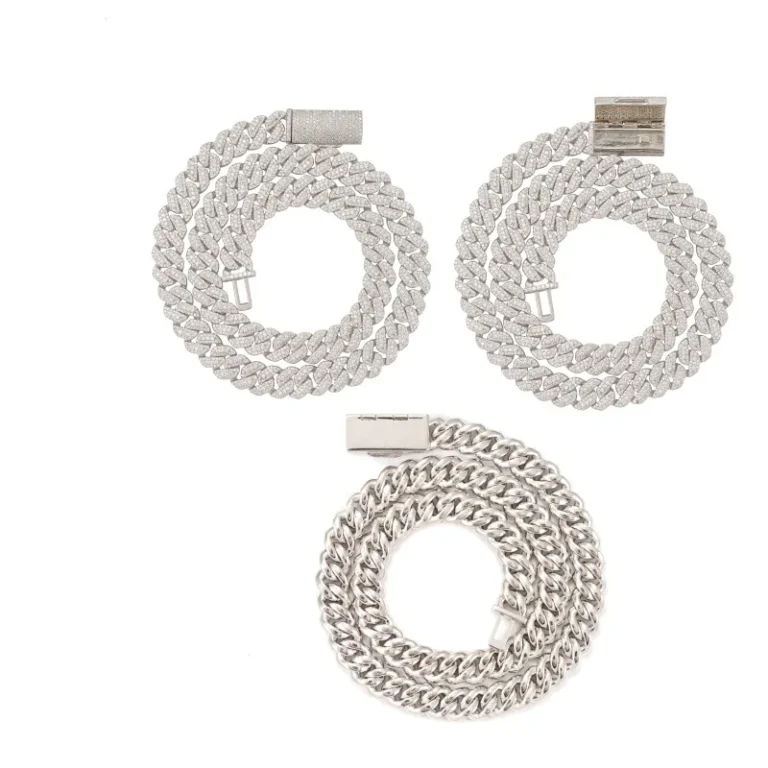
A few of our wholesale moissanite styles in 925 sterling silver, all available from 1 piece per style. Click any style for specifications and wholesale inquiry.
Frequently Asked Questions
Is moissanite worth buying?
If you want the look and durability of a diamond at a much lower price, yes. Moissanite will not hold resale value like a natural diamond, but it is a durable, brilliant stone that lasts for everyday wear.
Is moissanite expensive?
No, compared with diamond it costs a small fraction for the same size. The final price of a piece depends mostly on the stone size, the metal (silver or gold) and the setting work.
Does moissanite get cloudy?
No. Moissanite does not turn cloudy over time. Dirt, oil and lotion can make any stone look dull, and a simple clean brings the sparkle back.
Is moissanite a lab-grown diamond?
No. Both are made in a lab, but a lab-grown diamond is carbon (a real diamond) and moissanite is silicon carbide (a different gemstone).
What does a GRA certificate mean for moissanite?
GRA is the grading report most commonly supplied with moissanite. It records the stone’s color, clarity, cut and size, and a number laser-inscribed on the girdle links the stone to its report.
Source Moissanite Jewelry from Our Factory
JOVEGEM makes moissanite jewelry in 925 sterling silver in our own factory in Ningbo, China, with D color VVS1 moissanite grown and cut in-house and a GRA certificate with every piece. We supply jewelry brands, retailers and online sellers with 500+ in-stock styles from 1 piece per style, and we offer OEM, logo engraving and custom designs.
Send us an inquiry or message us on WhatsApp for our wholesale catalog and price list.
