
GRA Moissanite Certificate: What It Is and How to Verify It
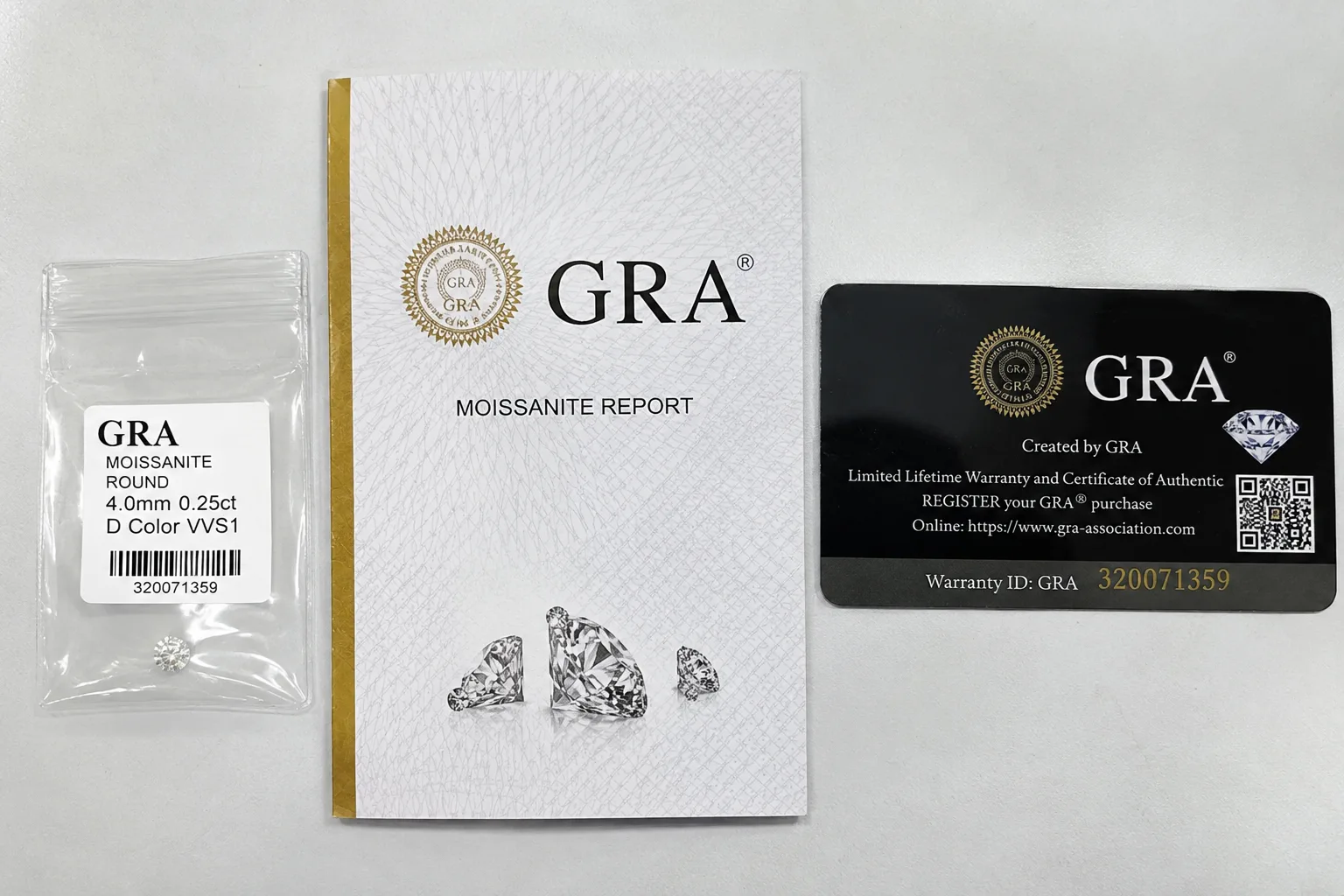
A GRA moissanite certificate is a grading report that identifies a stone as moissanite and records its size, shape, color and clarity. Each report has a unique number, and the same number is laser-inscribed on the girdle of the stone, so you can match the card to the stone and check the number online. It is the standard paperwork for moissanite, but it is not the same as a GIA or IGI diamond report, and it is only useful if the number really matches the stone you are holding.
We pack GRA-certified moissanite jewelry in our factory every day, and “is the GRA certificate real?” is one of the first questions new wholesale customers ask. This guide answers it honestly: what GRA is, what the report shows, how to verify it and what it does not tell you.
What Is GRA?
GRA is the grading report used across the moissanite trade. When a seller says a stone is “GRA certified” or “GRA moissanite”, it means the stone comes with a GRA report (usually a paper certificate plus a plastic card) and a matching laser inscription on its girdle.
It helps to be clear about what GRA is not. GIA and IGI are the major independent labs for diamonds; GRA is not part of that group, and a GRA report is not a diamond grading report. Think of it as an identification and quality record for moissanite: it confirms what the stone is and what it should look like, and it gives each stone a traceable number. For moissanite jewelry, that is exactly what most retailers and their customers need.
What Is on a GRA Moissanite Report?
| Report number | Unique ID, usually with a QR code for online lookup |
|---|---|
| Identification | Moissanite (lab-created silicon carbide) |
| Shape and cutting style | Round brilliant, oval, pear, emerald, princess, etc. |
| Measurements | Stone size in millimeters |
| Carat | Size class, usually diamond-equivalent (e.g. 1 ct = 6.5 mm round) |
| Color | For colorless stones, typically D |
| Clarity | Typically VVS1 |
| Cut, polish, symmetry | Usually Excellent |
| Inscription | The number laser-inscribed on the girdle |
A note on carat: moissanite is lighter than diamond, so a “1 carat” moissanite is normally a stone the size of a 1 ct diamond (6.5 mm round), not a stone that weighs exactly 1.00 ct. Always look at the millimeter size on the report. We explain this in more detail in What Is Moissanite?
How to Verify a GRA Certificate in 3 Steps
- Check the report number online. Scan the QR code on the card, or enter the report number on the verification website printed on the certificate. The record should come back and show the same shape, size, color and clarity as your card.
- Match the laser inscription. Look at the girdle (the thin outer edge) of the stone with a 10x loupe. The inscribed number must be the same as the report number. This is the step that links the paperwork to the actual stone.
- Check the stone itself. Confirm the size with a gauge or caliper, and look at the color and clarity against the report. A moissanite tester will also confirm that the stone is moissanite.
If the number cannot be found online, if the inscription does not match, or if the card looks generic with no number at all, treat the certificate as worthless, and ask the seller for an explanation before you pay.
Warning Signs of a Fake or Useless GRA Card
- No report number, or a number that does not exist in the online database.
- No laser inscription on the stone, or an inscription that does not match the card.
- The same card or the same number used for many different stones.
- A “D VVS1” card on a stone that clearly looks yellow, gray or included.
- A report that calls moissanite a “diamond” or “lab diamond”.
- Prices that are far below the market for the stone size and setting.
What a GRA Certificate Does Not Tell You
A GRA report is about the stone only. It does not tell you anything about the metal, the plating thickness, how securely the stone is set, or how well the piece is finished. It is also not a valuation or appraisal. For a jewelry buyer, those things matter just as much as the stone, so a good supplier should also tell you:
- The metal and its purity (for example, solid 925 sterling silver, stamped “925”).
- The plating (rhodium, 18K yellow gold or rose gold) and how it is applied.
- How each piece is inspected before packing: prongs, settings, clasps and polish.
- Whether you can send your own third-party inspector before shipment.
How GRA Certificates Work When You Buy Wholesale
With a good supplier, every moissanite piece ships with its own GRA certificate and card. On solitaire styles (an engagement ring, stud earrings, a solitaire pendant) the report describes the main stone. On pavé and tennis styles, the certificate comes with the piece; the tiny 1–2 mm stones are not graded one by one. Ask your supplier what each certificate describes before you order, so you can explain it correctly to your own customers.
At JOVEGEM, every piece is packed in an individual PP bag together with its GRA certificate and black GRA card, and each certified stone carries a laser-inscribed girdle number. Every piece is also checked by hand in our factory before packing, and you are welcome to arrange third-party inspection. You can see how we check stones and finished jewelry on our Quality & GRA page.
For retailers, the GRA card is also a selling tool. Customers like receiving a card that names their stone and its grade, and it reduces questions and returns. If you sell under your own brand, ask whether your supplier can pack the GRA card together with your own branded packaging.
GRA-Certified Moissanite Styles
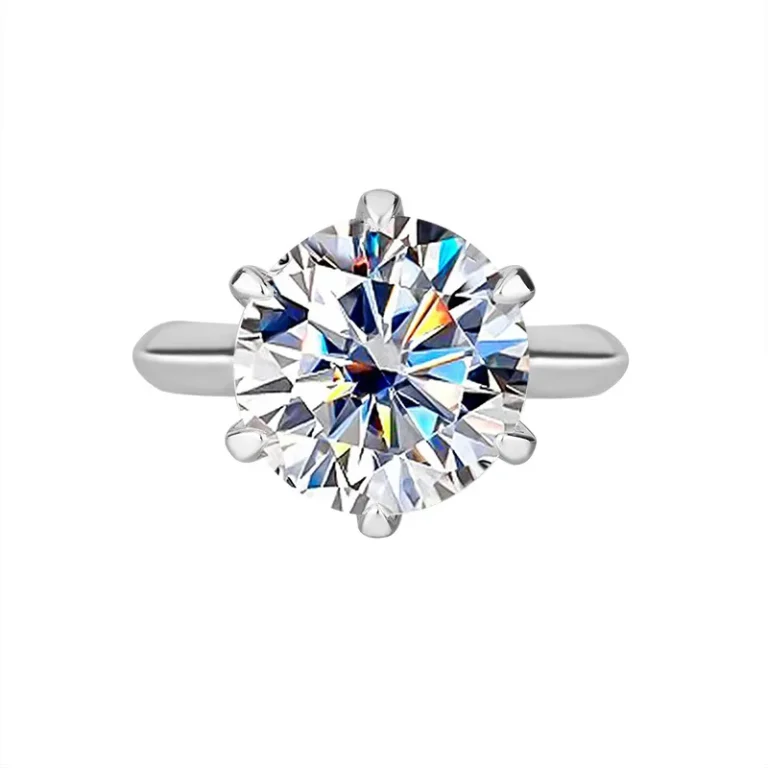
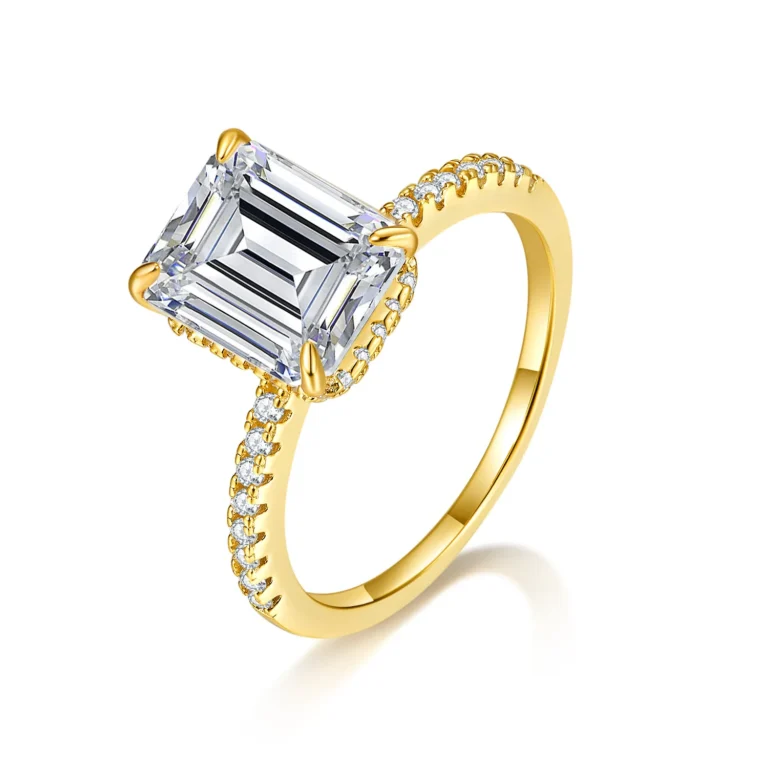
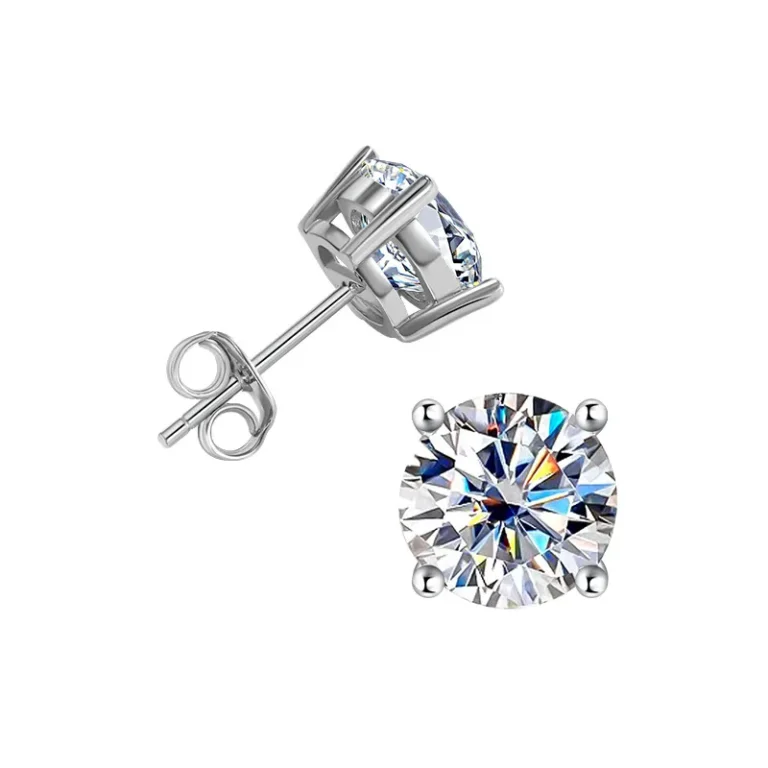
Solitaire styles like these come with a GRA certificate and card describing the center stone. Each one is available wholesale from 1 piece.

Frequently Asked Questions
Is GRA certified moissanite real moissanite?
A genuine GRA report identifies the stone as moissanite. The certificate is only meaningful if the report number can be verified and matches the inscription on the stone.
Is a GRA certificate as good as GIA?
No. GIA is an independent diamond lab with much stricter grading. GRA is the standard report for moissanite and is accepted by most moissanite retailers, but it should not be treated as a diamond grading report.
Where is the GRA number on the stone?
It is laser-inscribed on the girdle, the thin outer edge of the stone. You need a 10x loupe to read it.
Does a moissanite tennis chain come with a GRA certificate?
The chain comes with a GRA certificate as a piece, but the small stones are not graded one by one. Ask your supplier what the certificate describes for each style.
Can a GRA moissanite pass a diamond tester?
Moissanite usually reads as “diamond” on a basic thermal tester, whether or not it has a GRA report. A combined or electrical tester will identify it as moissanite.
Order GRA-Certified Moissanite Jewelry
JOVEGEM supplies 925 sterling silver moissanite jewelry with D color VVS1 stones and GRA certificates, from 1 piece per style, with OEM and logo engraving available. Send us an inquiry or message us on WhatsApp, and we will send our wholesale catalog with a sample GRA certificate photo.